

On 11 June 2026 the Supreme Court heard argument in R (Foodrise Ltd) v HM Treasury (UKSC/2025/0119, on appeal from HM Treasury v Global Feedback Ltd [2025] EWCA Civ 624). The question sounds narrowly technical: does a judicial review of tariff regulations fall within Article 9(3) of the Aarhus Convention, so that the claimant obtains environmental costs protection under CPR 46.24? Article 9(3) obliges each Party to ensure that the public can challenge acts and omissions ‘which contravene provisions of its national law relating to the environment’; Article 9(4) requires that such procedures not be prohibitively expensive; and the domestic costs-capping regime is how the United Kingdom performs that obligation. The scope of ‘national law relating to the environment’ therefore sets the price of environmental judicial review. The decision handed down will be the UK’s most significant ruling on access to environmental justice.
That price is itself now in play. On 13 November 2026 the Guardian reported lawyers’ accounts of private Ministry of Justice discussions with selected stakeholders about changes to the costs regime itself: higher claimant caps, new exposure for crowdfunded claims, and the removal of protection where a court finds ‘misuse’ of judicial review (‘Right to make green challenges to planning decisions under threat, say UK lawyers’, 13 November 2026). The boundary of the regime is before the Supreme Court; its price, it appears, is before the Ministry. I return to both, and to what the available data can and cannot tell us about either, towards the end of this post.
My argument in this post (developed at greater length in an article on the Court of Appeal’s judgment, K Jha, ‘Cabined, Cribbed, Confined: Form, Purpose, and the Boundaries of Environmental Law’ (2026) Journal of Planning & Environment Law 870) is that Foodrise presents one fault line at two levels, and that the oral hearing made both unusually visible. The fault line is between form and function. At the first, domestic level, the Court of Appeal drew the boundary of ‘environmental law’ by the formal purpose of the provision contravened, taken in the abstract, and on that basis held that ‘bare principles of public law’ can never qualify. At the second, interpretive level, the Government contends that the Aarhus Parties’ repeated, consensus endorsement of the Compliance Committee’s interpretation of Article 9(3) carries no primary interpretive weight because, it says, the Parties never agreed anything by endorsing the findings, and in any event the Committee is not a court. Both moves judge a legal norm by the category of its source rather than the function it performs; at both levels, the functional question is the right one.
I attended the hearing. Quotations from the exchanges below are taken from my own contemporaneous notes; they are close paraphrases rather than a transcript. The panel composition: Lord Sales, Lord Hamblen, Lord Leggatt, Lady Simler and Lord Doherty.
Foodrise Ltd (formerly Global Feedback Ltd) challenges the making of the Customs Tariff (Preferential Trade Arrangements and Tariff Quotas) (Australia) (Amendment) Regulations 2023, which give effect to tariff preferences under the UK–Australia Free Trade Agreement. Its case is that Australian beef production is substantially more emissions-intensive than domestic production, so the preferences will produce ‘carbon leakage’, and that the ministers failed to discharge the duty in s.28 of the Taxation (Cross-border Trade) Act 2018 to have regard to relevant international arrangements (here the UNFCCC, including Article 4(1)(f)) with associated rationality and Tameside grounds. Lang J granted permission and a costs limit order ([2024] EWHC 1943 (Admin)). The Court of Appeal (Holgate LJ, with whom Stuart-Smith and Coulson LJJ agreed) reversed on costs: Article 9(3) applies only to a contravention of ‘a legal provision which concerns, or is to do with, the environment, its protection or regulation’ (at [96]); ‘put in a nutshell, what matters is whether the purpose of the national law that has allegedly been contravened is to protect or regulate the environment, not whether the decision being challenged has an effect on, or some connection with, the environment’ (at [151]). Public law principles, here the duty to consider relevant material, fared worst: ‘the purpose of a bare principle of public law is not to protect or regulate the environment’, and such a principle ‘does not become’ environmental law ‘by being applied in a factual matrix which involves environmental impact or effect’ (at [142]).
The purpose test has a curious pedigree. It rests in part on Lesoochranárske zoskupenie VLK v Ministerstvo životného prostredia Slovenskej republiky (Case C-240/09) [2012] QB 606, the Brown Bear case, at [46], where the Court of Justice said that Article 9(3), ‘although drafted in broad terms’, is intended to ensure effective environmental protection. That is a statement about the purpose of the Convention provision. The Court of Appeal (at [78]–[79]) reads it as support for requiring that the national provision have environmental protection as its purpose — a different proposition, never articulated by the Court of Justice (‘the CJEU does not say this’, as counsel for the Appellant put it). The Government’s answer in its written case, that [46] is a purpose statement made in a case about something else entirely (standing), takes the authority away from the Court of Appeal as much as from the Appellant.
What the hearing showed to be common ground is itself revealing. First, the interpretive framework: both sides worked within Articles 31–33 of the Vienna Convention on the Law of Treaties and the ‘single combined operation’ the Supreme Court has recently restated (Kingdom of Spain v Infrastructure Services Luxembourg Sàrl [2026] UKSC 9 at [75]). Second, ‘provisions of national law’ is not confined to legislation: Sir James Eadie KC accepted, in answer to Lord Sales, that common law provisions can qualify (as Austin v Miller Argent (South Wales) Ltd [2014] EWCA Civ 1012, [2015] 1 WLR 62 had already held for private nuisance). Third, nobody defended a pure effects test: Lord Leggatt observed that everyone appeared to accept the inquiry was in some sense purposive, and no one contended that environmental effects alone sufficed. The genuine dispute is therefore about the connector, ‘relating to’, and about what it connects: the provision characterised in the abstract (the Government), or the legal obligation as it operates in the claim (the Appellant).
Victoria Wakefield KC opened for the Appellant with the domestic-law case: a provision falls within Article 9(3) where there is some discernible, sufficiently bespoke purpose or object related to environmental protection, which might reside in the vires, in a procedural obligation (e.g. a duty to carry out environmental assessment), or in obligations generated by policy. The ‘vice’ of the Court of Appeal’s judgment, she submitted, is that it carves out types or areas of law from Article 9(3), while the Convention’s language directs attention to the relationship between the law contravened and the environment.
The panel pressed, repeatedly and from several directions, for the limiting principle. Lord Sales at one point put it bluntly — ‘give us the formula’ — and directed oral argument to statutory purpose, a topic about which he has written volumes. A tentative postulation of the formula came: ‘any relationship with the environment other than one which is collateral or incidental’, and the riposte was immediate: what makes a connection collateral or incidental, if not its relationship to the purpose of the provision? The formula collapses back into the test it was meant to replace. Lord Hamblen offered an alternative route through a causal test distinguishing direct from indirect impacts, but neither the Appellant nor the Government advocated a test based on effects. For the Appellant, the anxiety was that ‘purpose’ applied at the level of individual considerations would be construed narrowly and strip Article 9(3) of much of its practical scope; Wakefield’s closing move in reply was to take up a suggestion Lord Hamblen had floated in the morning: ‘relating to’ is a question of subject matter rather than purpose, a formulation that gestures at function rather than the enacting Parliament’s purpose.
The ambiguity about purpose is of the Court of Appeal’s making. Holgate LJ’s judgment treats ‘relating to the environment’ as a binary, in that a provision either relates or it does not, while conceding elsewhere that the strength of ‘relating to’ (the ‘connector’) varies with context. If the connector is scalar, the true question is one of sufficiency: not ‘does this provision relate to the environment?’ but ‘does it relate sufficiently for Article 9(3) purposes?’ A binary test conceals the intermediate category, that is, provisions not primarily environmental in purpose that nonetheless bear a sufficiently environmental character in the claim at hand. It was this concealed category that both proposed formulas kept stumbling over. In the article I propose a materiality test for this ground: a claim falls within Article 9(3) where the act or omission alleged to contravene national law is materially connected to the environmental elements, factors and measures defined in Article 2(3), legislative intent being one factor in assessing materiality. Whatever one makes of that proposal, the hearing showed the cost of forcing a spectrum question into a classification answer: each side’s bright line frayed on contact with the other’s hypotheticals, which ranged from school boilers to procurement and the National Planning Policy Framework.
One further thread: the word ‘alleged’. The costs gateway necessarily operates before the merits are known, and the Appellant argued that unsuccessful claimants must be capable of protection; otherwise the regime protects only winners. The Government’s answer (Respondents’ written case, §§29–30) is that applicability must be determinable at the outset by characterising the provision said to be contravened. Lord Doherty intervened with a very Scottish point: the court should assume the claimant’s case pro veritate; Eadie’s reply was that the Court did not need to go there. Lord Sales probed the gateway–merits interaction from both ends: the strong case for the Government is the unarguable claim in environmental clothing; the strong case for the Appellant is the properly arguable claim that fails. One must be sympathetic to a permission judge evaluating a claim on the papers, but on any view they must characterise something at the outset. The question is only whether it is the provision’s abstract purpose or the claim’s environmental character.
A classic public law debate anchored some of the most interesting exchanges at the hearing. The Court of Appeal’s excluded category, ‘bare principles of public law’, presupposes that grounds of judicial review have a fixed, context-free character: a purpose of their own (‘to regulate the lawfulness of decisions… irrespective of the various functions’ public authorities carry out (at [142])) which is never environmental. The Environmental Law Foundation’s intervention (Richard Wald KC and others) attacked that premise at its constitutional root, through an angle that many students of public law probably loathe. The basis of judicial intervention in public law is the doctrine of ultra vires: powers are conferred on the assumption that they will be exercised within jurisdiction, fairly, and reasonably (Boddington v British Transport Police [1999] 2 AC 143, 171, per Lord Steyn). The operative content of any public law principle therefore depends on the statutory context in which it is applied. The Supreme Court has said as much in the environmental context: in R (Friends of the Earth Ltd) v Secretary of State for Transport [2020] UKSC 52 at [117], Lord Hodge and Lord Sales, drawing on CREEDNZ Inc v Governor-General [1981] 1 NZLR 172, treated the doctrine of relevant considerations as an exercise in identifying what the statute, expressly or impliedly, requires. ELF’s synthesis sought to clearly render the so-called modified ultra vires view (§22.2): whether (i) a statute expressly identifies a consideration, (ii) a general duty to consider relevant matters is found on analysis to include a particular factor, or (iii) the common law requires regard to a consideration when a statutory power is exercised, ‘the constitutional analysis is the same: Parliament’s intention is that the decision-maker must have regard to that factor.’
For readers who do not live in this doctrine: R v Somerset County Council, ex p Fewings [1995] 1 WLR 1037 distinguishes considerations a statute requires, prohibits, or leaves to the decision-maker’s discretion; the CREEDNZ gloss, affirmed in Friends of the Earth, is that a discretionary consideration (‘Fewings 3’) becomes obligatory where it is so ‘obviously material’ that ignoring it would not accord with the intention of the Act. The Court of Appeal (at [136], [142]–[143]) treats claims founded on implied mandatory considerations, or on irrationality in handling voluntarily considered factors, as invoking only ‘bare’ public law, outside Article 9(3) unless the enabling statute is itself environmental in purpose.
At the hearing this became the axis of the sharpest exchanges, driven largely by Lord Sales, co-author of the very paragraph of Friends of the Earth on which the interveners rely, and on record extra-judicially that ‘in relation to judicial control of the exercise of statutory powers, it is the ultra vires doctrine which governs’ (P Sales, ‘Rationality, Proportionality and the Development of the Law’ (2013) 129 LQR 223, 229). To Wakefield, he put the point in a form that helped her: where a decision-maker chooses to take the environment into account (again, Fewings 3) and public law then constrains how that is done, the relationship to the environment runs through Parliament’s conferral of the choice — ‘it’s that Parliament has given the power to consider’. To Eadie, he put the same point as a challenge: if there is a mandatory consideration requiring assessment of environmental effects, that requirement ‘is built into the legislative scheme itself’; and where the requirement arises as an implicit feature of the scheme rather than an express one, ‘the legal effect is the same in either case’ — so what is the principled distinction the Government’s test depends on? Lady Simler pressed the complementary question: was Eadie really drawing a line between mandatory and voluntarily adopted considerations, or directing attention to the character of the underlying scheme? Eadie’s consistent answer was the latter, plus a charge of circularity: if the underlying scheme is, on its proper construction, a trade and customs statute, it cannot be converted into environmental law through public law grounds attached to environmental facts. The Appellant’s approach, he said, is ‘self-fulfilling’. Lord Leggatt offered the Government’s best formulation of the same idea: it is not enough that a decision-maker is obliged to take into account an environmental matter; there must be an environmental legal obligation. Public law must be grafted onto an environmental provision, not the environmental subject matter grafted onto public law. Lord Hamblen came at the same line from the other side. In the morning he had put the Fewings 3 case on the facts: the ministers themselves chose to look at greenhouse gas emissions, so if they breached their public law obligations in doing so, that is environmental law. In the afternoon, once Eadie had reformulated the Government’s test around the ‘underlying legislative scheme’, Lord Hamblen asked point-blank whether the Government defended the Court of Appeal’s [136] (on bare principles of public law) at all. The express/implied distinction was thus pressed from two directions, and the Government’s answer to both was the circularity charge. The charge assumes that a statute has a prima facie character ascertainable before one asks what it requires in the case in hand. It arguably does not: identifying what s.28 obliges a minister to consider is construing s.28. If the answer is the UNFCCC, the character of that obligation is not imported, but internal to the statute.
The constitutional significance should be drawn out, and that exercise requires identifying the theory of judicial review the Court of Appeal’s category relies on. On the common law account, the grounds of review are free-standing judicial standards, and an invariant, non-environmental purpose is at least an intelligible attribute for them to have. Even the modified ultra vires theory of Forsyth and Elliott leaves that picture available: there the grounds remain a judge-made body of general principle, merely authorised by Parliament’s general intention that the rule of law be observed. A general body of principle can be assigned a general purpose (though even there, a breach operates as an excess of the particular power conferred). The real challenge comes from the traditional understanding, recently revitalised by Alexander Latham-Gambi (‘Sovereignty, the Rule of Law and the Nature of Legislation: Reconceptualising the Traditional Ultra Vires Theory’ [2024] PL 109): the grounds as implied terms of the particular grant, worked out by interpreting the specific scheme rather than by applying judicially sanctioned rules. On that account the idea of a free-standing ‘principle of public law’ is a category with no referent. There is no principle to be contravened at all because what is contravened is always the enabling Act, read as Parliament must be taken to have intended. The Appellant, however, does not need to win the foundations debate, and would be unwise to try. What it needs is narrower: relevant considerations is, as settled doctrine, an exercise in construing the enabling Act (Friends of the Earth at [117]), so the character of that ground in a given case is fixed by the scheme and subject matter to which it attaches, not the doctrinal shelf it is taken from.
There is an irony here that the interveners exploited: the Court of Appeal’s reconciliation of Venn v Secretary of State for Communities and Local Government [2014] EWCA Civ 1539, [2015] 1 WLR 2328 depends on Parliament’s intention in the planning legislation (at [145]). Parliamentary intent is thus permitted to do interpretive work when it excludes a claim from Article 9(3), but implication is denied the same office when it would include one. The post-judgment case law shows the arbitrariness in practice: in Green Lane Association v Central Bedfordshire Council [2025] EWHC 2251 (Admin) costs protection turned on the fortuity that the Road Traffic Regulation Act 1984 happens to mention air quality expressly, a working demonstration of the drift Latham-Gambi warns against, from principle to the classification of statutes into judicially created categories. The decisions since show the same mechanics. In R (Royal Mint Court Residents’ Association) v Secretary of State for Housing, Communities and Local Government [2026] EWHC 904 (Admin), a challenge to national security measures for the Chinese embassy site was held ‘one step removed’ from environmental law (at [20]–[21]). In R (Peart) v Secretary of State for Environment, Food and Rural Affairs [2026] EWHC 2052 (Admin) and Hall v Secretary of State for Environment, Food and Rural Affairs [2026] EWHC 2623 (Admin), claims about a farm subsidy and a native breeds list were protected because the schemes count environmental protection among their purposes. And in Northern Ireland, Re Lynch’s Application (No 4) [2026] NIKB 41 protected a challenge to an EIA screening decision on a test ‘focused solely upon the nature and purpose of the national legal provision’ (at [22]). Each turned on what the enabling scheme says about itself rather than the character of the claim. Whichever way Foodrise is decided, the Court will have to say something about the sources and character of the grounds of judicial review. With the case clothed in such constitutional finery, it is easy to forget that Foodrise is a costs appeal.
The second level of the form/function fault line concerns treaty interpretation itself. The Appellant relies on findings of the Aarhus Convention Compliance Committee: Austria (ACCC/C/2011/63, §52), which reads Article 9(3) as covering ‘any law… which may relate in general to, or help to protect, or harm or otherwise impact on the environment’; the United Kingdom nuisance findings (ACCC/C/2013/85 and 86); and the Czech Republic findings (ACCC/C/2010/50), which caution against any narrow reading. The Meeting of the Parties endorsed each by consensus, and has reaffirmed each since.
The key finding in Austria, if applied plainly, gives the Appellant’s arguments the weight of a sledgehammer. Its third limb, laws which ‘harm or otherwise impact on’ the environment, is an effects test, and the Appellant disclaimed that genre of test, likely sensing that it would not land in the Supreme Court (written case, §34; and I note that Lord Leggatt’s remark that nobody was running this argument went uncontradicted). That key finding was therefore not why the Appellant relied on Austria. It was instead the rejection of the ‘environmental laws’ shorthand which the Court of Appeal adopted (at [107]). The Appellant’s written case pitches the endorsed findings of the Compliance Committee as subsequent agreement or subsequent practice under Article 31(3)(a) and (b) of the Vienna Convention: part of the general rule of interpretation, not merely a supplementary aid.
You would not have guessed it from the hearing. Wakefield began from the settled domestic position, that the Committee’s findings ‘deserve respect’ (Walton v Scottish Ministers [2012] UKSC 44 at [100], per Lord Carnwath), and from the common ground that the material is at least admissible under Article 32. Article 31(3) was put, but gingerly: consensus endorsement ‘would get us into’ it, counsel submitted, but the point was ‘delicate’, and ‘in any event [the parties] are agreed’ on Article 32. The one substantial development was the citation of Save Leitrim Environmental and Biodiversity CLG v Commissioner for Environmental Information (No 2) [2025] IEHC 663, in which Humphreys J, referring questions on the status of endorsed findings to the Court of Justice (the reference is pending), reasoned that ‘the endorsement of a conclusion must, in context, involve the endorsement of the reasons for the conclusion’ (at [37]). That fragment answers the Government’s severance point, that the Meeting of the Parties endorses outcomes and not reasoning; Eadie extended the point to the Irish case rather than engage with it, and the bench did not press him. But the Appellant’s case kept its concessive shape, with Article 32 as the agreed floor and Article 31(3) as an ambitious extra.
In other words, it was common ground that the Vienna Convention should be read upside down. Subsequent agreements and subsequent practice sit in Article 31, and the International Law Commission describes them as ‘authentic means of interpretation’, objective evidence of what the parties understood themselves to have agreed (ILC, Draft Conclusions on Subsequent Agreements and Subsequent Practice in relation to the Interpretation of Treaties, with Commentaries, UN Doc A/73/10 (2018)). It is the travaux that are supplementary. But domestic courts have long been prone to getting this the wrong way round. In Re Deep Vein Thrombosis and Air Travel Group Litigation [2005] UKHL 72 at [31], Lord Steyn treated Article 31(1) as the sole ‘starting point’, in effect relegating subsequent agreement and practice to Article 32 aids, whereas in Assange v Swedish Prosecution Authority [2012] UKSC 22 at [89]–[90] Lord Dyson correctly treated subsequent practice as a primary interpretive consideration. An advocate who treats Article 32 as safe ground and Article 31(3) as a delicate reach repeats part of Lord Steyn’s relegation, and risks inviting the Court to do the same. I suggest, tentatively, that this relegation owes something to a constitutional instinct. It is sensible to be wary of letting the executive alter the meaning of a treaty implemented by domestic law without Parliament’s imprimatur.
In fairness to the strategy, Eadie’s attack made the primary route a contested one, for the Government does not merely demote the endorsed findings to Article 32 but denies that they reach Article 31(3) at all. On the law, it says, Article 31(3)(a) sets the high bar of an authentic interpretation that ‘must be read into the treaty’ (Kasikili/Sedudu Island (Botswana/Namibia) [1999] ICJ Rep 1045, §49); when the Aarhus Parties intend an interpretive agreement they say so in terms (Decision III/1, which expressly invokes Article 31(3)(a)); and consensus adoption cannot ‘necessarily be equated with agreement in substance’ (the ILC’s caution). On the facts, Austria objected to the findings against it, and the Committee is, under Article 15, a ‘non-confrontational, non-judicial and consultative’ arrangement. And on authority, Special Rapporteur Nolte described the pronouncements of such bodies as ‘primarily designed to facilitate the agreement of the parties regarding the application of the treaty rather than playing a role in the interpretation of the treaty’ (Fourth Report, UN Doc A/CN.4/694 (2016), §93), while the WTO Appellate Body in Japan – Taxes on Alcoholic Beverages (WT/DS8/AB/R, WT/DS10/AB/R, WT/DS11/AB/R, 4 October 1996) held that adopted GATT panel reports were not ‘concordant, common and consistent’ practice and that ‘an isolated act is generally not sufficient’.
Three questions are run together in that argument, and they are better taken apart: what act is said to constitute the agreement, which limb of Article 31(3) it engages, and what follows if it does.
The act. It is the endorsement decision of the Meeting of the Parties, a decision of the Parties in plenary taken under the compliance arrangements which they established under Article 15 by Decision I/7. Nolte’s own report makes the point: of the Aarhus Committee in particular it says that its pronouncements, to become final, ‘always require the agreement of the party concerned or the endorsement of the Meeting of the Parties’ (§87; the sentence the Government quotes, at §93, is a summary across four treaty bodies), and the ILC’s final text follows, in providing that a pronouncement of an expert treaty body ‘may give rise to’ a subsequent agreement or practice of the parties (Conclusion 13(3)). The Government relies on the rest of Nolte’s sentence, that the agreement so facilitated concerns ‘the application of the treaty rather than… the interpretation of the treaty’. But Article 31(3)(a) extends in terms to agreements regarding ‘the application of its provisions’. On Nolte’s account, then, the Committee helps the parties agree on how the Convention applies, and where they agree Article 31(3)(a) takes that into account.
Nor does Article 15 answer the point. It describes the character of the review arrangements; whether a decision of the Parties expresses their agreement on meaning depends on what it says, ‘regardless of the form and the procedure by which the decision was adopted’ (Conclusion 11(3)). Behind Article 31(3) lies the old idea that authoritative interpretation belongs to ‘the person or body who has power to modify or suppress’ the instrument (Question of Jaworzina, Advisory Opinion, PCIJ Series B No 8 (1923), 37), though in the weaker form of an authentic means to be taken into account. Authority under Article 31 grows as one nears the parties, not as a body comes to resemble a court, and it is the Committee’s non-judicial design which makes the operative act the Parties’ own.
The limb. Article 31(3)(a) requires a subsequent agreement ‘regarding the interpretation of the treaty or the application of its provisions’; Article 31(3)(b), subsequent practice ‘in the application’ which establishes the parties’ agreement regarding interpretation. The Government’s point about Decision III/1 answers limb (a) only, and answers it weakly, since the Vienna rules impose no formality: an agreement ‘may, but need not, be legally binding’ (Conclusion 10), and a decision of a Conference of States Parties embodies one ‘regardless of the form’ where it expresses agreement in substance (Conclusion 11).
It is limb (b) which gives the Appellant its stronger route. Three decisions in seven years, V/9b (2014), VI/8b (2017) and VII/8b (2021), each endorsing the Austria reading by consensus, with a parallel line on the UK nuisance findings from 2017, are practice in the application of the Convention. Whether that practice establishes the agreement of the parties is a question of fact about what they did and said, and the ILC’s caution that consensus adoption cannot ‘necessarily be equated with agreement in substance’ (commentary to Conclusion 11, para (30)) is directed at decisions adopted over expressed divergence. Here the record runs the other way. Austria, whose ‘objection’ the Government relies on, commented adversely on the draft findings in 2013 and made a statement at the fifth session, and then joined the consensus on V/9b and on both reaffirmations. An objection to a draft is not a reservation to the decision, and a party which chooses not to reserve should be taken to acquiesce (Conclusion 10(2)). And parties know how to withhold consent: in 2017 the European Union declined to join the endorsement of findings against its own standing rules. As in contract, silence is not presumed to be acceptance (Conclusion 13(3)). But endorsement by consensus is not silence.
The WTO authority. This is where Japan – Alcoholic Beverages belongs, because it was a limb (b) case, and read as a whole I think it can be distinguished. The Appellate Body gave two reasons why adopted GATT panel reports were not ‘concordant, common and consistent’ practice. One was that ‘the decisions to adopt panel reports under Article XXIII of the GATT 1947 were different from joint action by the CONTRACTING PARTIES under Article XXV’: to settle a dispute between two parties is not to act together. The other was that the WTO Agreement confers ‘exclusive authority’ to adopt interpretations on the Ministerial Conference and General Council (Article IX:2), and an authority so specifically conferred ‘does not exist by implication or by inadvertence elsewhere’.
Neither reason touches Aarhus. An endorsement decision is joint action by the parties and not the outcome of a two-party dispute, and the Convention contains no carve-out of the Article IX:2 kind: the Meeting of the Parties is the body in which the parties act jointly, the counterpart of the very organs in which the WTO vests interpretive authority. In the ILC’s taxonomy its decisions sit with those of Conferences of States Parties (Conclusion 11), not with adjudication. Nor is a finding endorsed once and twice reaffirmed ‘an isolated act’. And the one thing which the Government might have taken from the report it did not take: adopted panel reports, the Appellate Body said, are ‘an important part of the GATT acquis’ and ‘should be taken into account where they are relevant to any dispute’, which is interpretive weight short of Article 31(3)(b). Read whole, the Government’s strongest authority states a test which the Appellant’s material meets and a fallback for which the Appellant would settle.
What follows. Less than either side’s rhetoric suggests. An Article 31(3) agreement is ‘to be taken into account, together with the context’; it is not read into the treaty as if it were text (the ‘read into the treaty’ language in Kasikili/Sedudu concerns authentic interpretations which the parties intended as such), and the ILC makes its weight depend on clarity and specificity and on whether and how the practice is repeated (Conclusion 9). The honest claim is therefore not that the endorsements are conclusive but that they carry weight within Vienna’s single combined operation: an interpretation which the parties have three times endorsed by consensus should count for more than a contested drafting record of 1997 which is itself under challenge as inadmissible, and a court which declines to give it that weight should say why. To judge the agreement by the body that drafted the words, and not by the parties who adopted them, is to prefer form to function for a second time. It is the same fallacy, one floor up.
Four questions await the judgment, and it is unlikely all will be answered:
1. Is a compliance decision addressed to one party and endorsed by all a subsequent agreement under Article 31(3)(a), or subsequent practice under Article 31(3)(b) that may establish one? Does repetition in 2014, 2017 and 2021 convert the one into the other?
2. What weight does such an agreement carry when it points one way and the travaux another? Does a domestic court applying the Vienna rules to an unincorporated treaty, incorporated by reference in CPR 46.24, answer that differently from an international tribunal?
3. Is the Committee’s non-judicial character a reason to discount its output, or the very feature that locates interpretive authority with the parties? Which way will a court go whose instincts run to court-likeness?
4. Is the eighth session of the Meeting of the Parties, with the deferral the United Kingdom sought and the reservation it entered, practice confirming the mechanism, or the expressed divergence the ILC says consensus cannot paper over? If the latter, for which decisions?
At their eighth session, in Geneva in November 2025, the Parties decided by consensus to postpone decision-making on draft decision VIII/8u, concerning the United Kingdom’s compliance, to the ninth session in 2029 or to a possible extraordinary session (ECE/MP.PP/2025/2, §49), the UK having tried and failed to have the item removed from the agenda altogether (§9). It was the first session at which the endorsement machinery buckled in respect of the UK, and the Government may be expected to make something of it.
What was held over was the whole of the United Kingdom’s compliance file: new findings on public participation in the preparation of legislation (ACCC/C/2017/150), and the Committee’s follow-up on prohibitive expense under decision VII/8s, so that the price of environmental litigation was among the matters postponed. So was the Committee’s response to the Court of Appeal, for its report to the session had recalled Austria and invited the United Kingdom ‘to explain why regulations challenged on the basis of their alleged substantial effects on the environment, such as alleged adverse impacts on climate change, do not constitute part of its “national law relating to the environment”’ (ECE/MP.PP/2025/66, §75), which is an invitation to explain and not a finding. But the interpretive findings relied on in Foodrise were not postponed. The Austria scope finding (2014, reaffirmed in 2017 and 2021) and the UK nuisance findings (2017, reaffirmed in 2021) stand endorsed, with the UK inside the consensus each time. What the eighth session changed was the tense of the dispute, not the status of what had been endorsed.
Three features of the episode in fact help the Appellant. One is the UK’s formal reservation (§47), which reserves its position on ‘any new interpretations of, or recommendations relating to, its obligations… that may arise from’ the decisions adopted at the session, and which thereby concedes the mechanism: it treats endorsement as an act from which interpretation arises, and objects only to being held to the result. One does not reserve against a nullity. Another is that Norway and Switzerland placed on record that the endorsement of Committee findings is the ‘long-standing and consistent practice’ of the Parties, integral to the compliance mechanism, from which the postponement was an exceptional and unwanted deviation (§50). That is the parties’ own testimony, given at the time, to the concordant, common and consistent practice which the Government’s WTO authority demands.
And the sequel points the same way. When the Committee asked the United Kingdom in April 2026 for a plan of action, the reported answer, in June, was that none was appropriate because draft decision VIII/8u ‘was not endorsed by the Meeting of the Parties’ (as recorded in Landmark Chambers, Aarhus blog no 84, 2 July 2026). On the Government’s own account, then, a Committee finding does its work only once the Parties have endorsed it, and that is the Appellant’s answer to the first question, what act. The act that matters is the Parties’.
If Article 31(3) was under-argued, Article 32 was fought hard, which is itself a symptom of the inversion. Successive negotiating drafts of what became Article 9(3) referred to ‘national environmental law’; at the eighth negotiating session, in December 1997, the English and Russian texts were changed to ‘national law relating to the environment’, while the French (‘les dispositions du droit national de l’environnement’) was left as it was. On the unchanged French the Court of Appeal relied as confirming that the change was not substantive (at [85]–[88]). It did not address the Russian text at all. Since then the evidence has moved. Friends of the Earth’s intervention supplies certified translation evidence that the French can bear both meanings, so that it needed no amendment to be broadened; and the Appellant relies on the witness statement of Jeremy Wates, who attended the negotiations for the ECO Forum coalition of environmental NGOs and who exhibits an in-session note and a contemporaneous ECO Forum report recording that the change was agreed precisely in order to extend the provision beyond ‘national environmental law’.
Eadie’s riposte was procedural, and it was new. To be admissible as supplementary means, he submitted, materials must be public and accessible, a requirement drawn from the Court’s recent restatements of the Article 32 conditions, among them Lord Hamblen’s judgment in JTI Polska Sp z oo v Jakubowski [2023] UKSC 19, here cited to its author. His target is the full ECO Forum report, which the Government says was never circulated in the requisite sense; the Appellant answers that a summary was published and the full report was available on request, which it says suffices on the principles in Fothergill v Monarch Airlines Ltd [1981] AC 251, 278. Against the in-session note the objection sits less easily. On the Appellant’s account of the Wates evidence the secretariat circulated it during the session, which puts it closer to the party-produced material received in Oil Platforms (Islamic Republic of Iran v United States of America) (Preliminary Objection) [1996] ICJ Rep 803 than to an NGO’s own record, though the Government distinguishes Oil Platforms on exactly that ground, the documents there having been both plainly public and produced by a party to the treaty, which ECO Forum is not. Lord Leggatt’s audible scepticism cut both ways: ‘these nuances are rather subtle’, he observed, doubting that they would shed much light.
Whatever its merits, the publicness objection controls Article 32 and nothing else, and in doing so it shows why Article 32 material is supplementary. Pre-ratification records are at best second-hand evidence of what the parties intended, and their provenance, circulation and translation can all be disputed, as the argument over the Wates evidence showed. No such weakness attaches to the endorsement decisions, which are published United Nations documents recording what the parties themselves did, together, after ratification. So the Government’s position comes to this: that the Court should immerse itself in a contested drafting record of 1997, translation evidence and admissibility challenge included, while giving no primary weight to what the parties have plainly and publicly done in plenary session ever since. To prefer the archive to the living practice, and the moment of drafting to the parties’ continuing agreement, is the formal move again.
A caution, though, for the Appellant’s supporters. Even total victory on the language point is housekeeping, because Holgate LJ reached his purpose test independently of the French text (at [75]–[81]).
While the appeal has been pending, the other half of the regime has changed. Article 9(3) determines which claims are protected; CPR 46.26 caps the price (a claimant’s liability capped at £5,000 or £10,000, a defendant’s at £35,000). In November 2025 the Nuclear Regulatory Taskforce recommended (Recommendation 20) that protection be withdrawn where judicial review is misused, that the caps be uprated for inflation and doubled at each stage of a challenge, and that a crowdfunded claimant’s cap be set at 70 per cent of the funds raised. The Government’s response of 13 March 2026 (Building Our Nuclear Nation) adopted none of those mechanisms in terms, but it undertook to ask the Civil Procedure Rule Committee to amend the Environmental Costs Protection Regime by the end of 2027, so as to deter misuse while maintaining access to justice and compliance with international obligations, and the Rule Committee’s minutes of 8 May 2026 record the requested amendments as future business. The Guardian reported on 13 November 2026 private meetings at which proposals of the Taskforce’s kind were discussed, and it carried the Government’s answer: there are ‘no plans to remove costs protections for well-founded claims’.
Two things about that answer bear on the appeal. One is the word ‘well-founded’. A costs gateway operates before the merits are known, which was the point of the exchange about ‘alleged’ contraventions and of Lord Doherty’s pro veritate; a regime that protects well-founded claims protects winners, who need it least, and Article 9(4) is addressed to the cost of the procedure, not to the fate of the claim. The other is that the scope of protection and price are both in flux. The Court of Appeal’s test turns the first, the Taskforce’s proposals would turn the second, and the Parties’ decision on whether the United Kingdom’s existing regime meets Article 9(4) stands postponed.
What does the evidence show? The fullest public count of Aarhus claims is the series which the Ministry of Justice released under the Environmental Information Regulations to the authors of A Pillar of Justice (RSPB and Friends of the Earth, 2019) and A Pillar of Justice II (RSPB, Friends of the Earth and ELF, 2023). Pooled, the two series run from 1 April 2013 to 31 July 2022: 1,151 claims in a little over nine years, never more than about 180 in a year; 471 granted permission; 95 allowed at a substantive hearing, about ten a year.
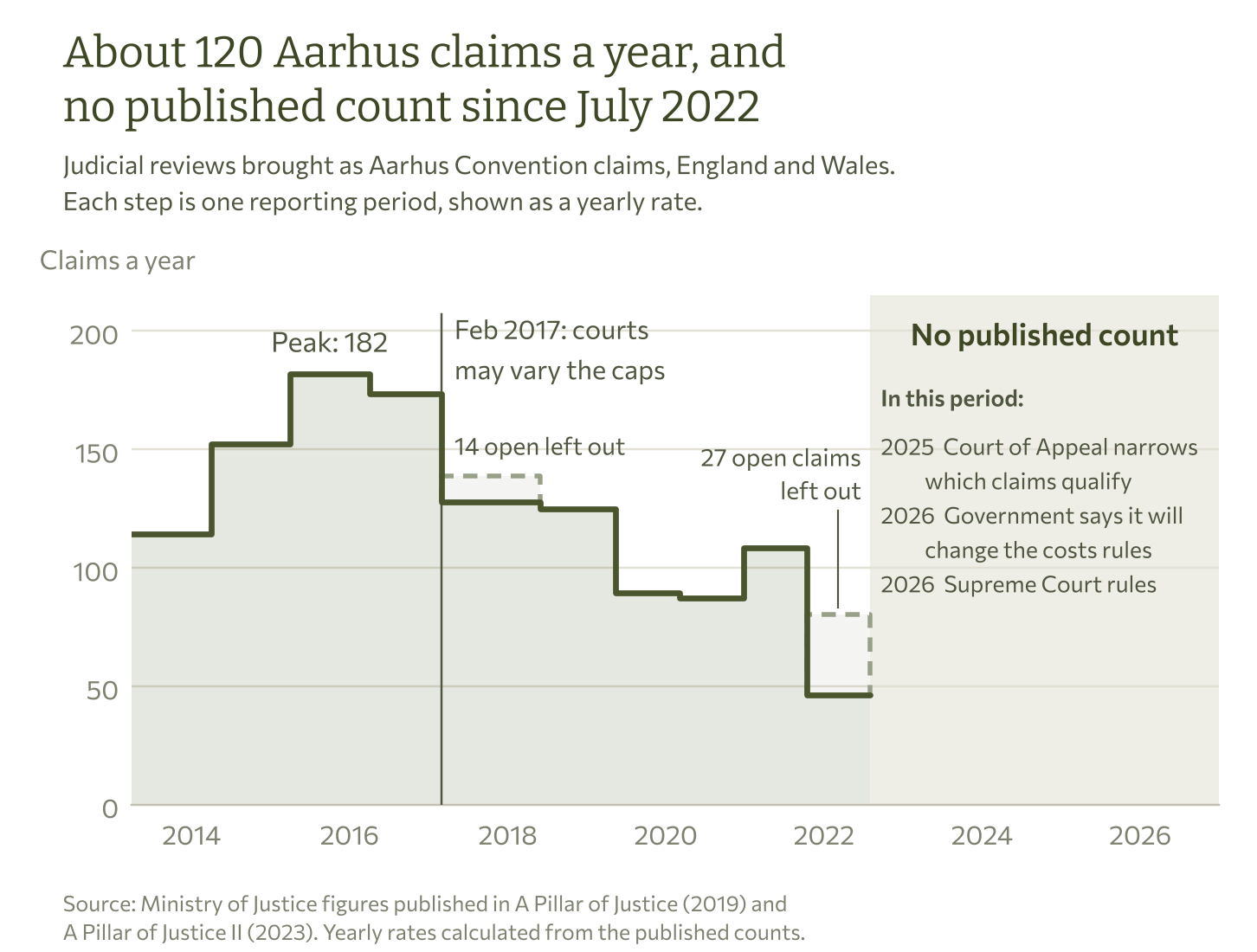
Figure 1. Aarhus claims in England and Wales, April 2013 to November 2026.
Set beside the Ministry’s own case-level judicial review data (Civil Justice Statistics Quarterly: April to June 2026; the calculations are mine), the picture is unglamorous. Permission was granted to 41 per cent of Aarhus claims and to 40 per cent of planning judicial reviews lodged over the same period, against 22 per cent of other civil, non-immigration judicial reviews. And once permission is granted the rate of success is the same in every class: about one in five. So the premium which the reports found against judicial review as a whole is real, but it is a planning premium at permission stage. Planning claims do pretty well: of those decided on the papers in 2019–2022, 2.6 per cent were certified totally without merit, against 14.8 per cent of Administrative Court judicial reviews generally, and of 28 recorded defendant challenges to Aarhus status between May 2019 and July 2022, one succeeded. (Both sources count only claims allowed at a hearing, so settlements are not captured, and the Aarhus series omits cases still open when the data were drawn, which understates its later periods.) Limited as they are, the data here do not suggest misuse of costs protection.
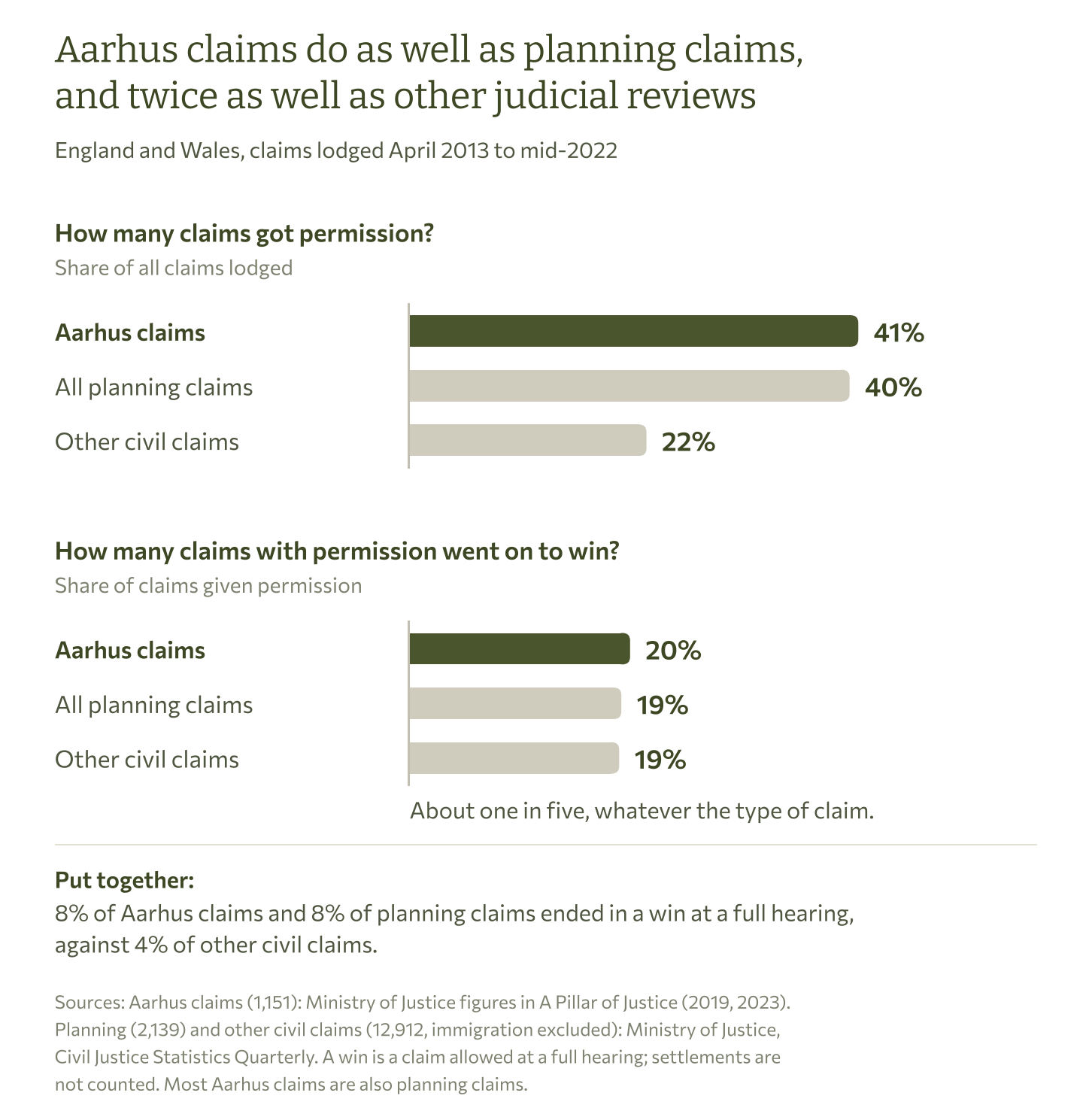
Figure 2. How Aarhus claims fared against planning and other civil judicial reviews, 2013 to 2022.
The more telling facts concern the count itself. It was, first, a count by case topic area. The Ministry’s software, the authors of the second report were told, recognised only certain case topics as potential Aarhus claims, which is why Aarhus claims and planning claims look alike in the figures: to a large extent they are the same claims. It also means that a claim like Foodrise’s, brought against the Treasury about a customs tariff, may never have been counted at all. To that extent the official record had the Court of Appeal’s conception of an Aarhus claim built into it before the Court of Appeal stated it. An Aarhus claim was a claim filed under an environmental heading.
Secondly, the data coverage is poor. The last figures are for July 2022, and the Ministry told Wildlife and Countryside Link in November 2024 that its replacement case-management system does not record Aarhus claims (Ministry’s call for evidence, 6 December 2024). Nor can the public data fill the gap. They show planning judicial reviews continuing at 16 to 19 a month; they cannot show how many claimants have sought protection since 2022, how many were refused it after the Court of Appeal judgment, or how many never issued.
Public lawyers at large have three reasons to care. The first is access to justice. It is the scope of Article 9(3) which fixes the practical availability of environmental judicial review, and the interveners’ evidence put flesh on that: ELF’s Case Director explained that historically all of its clients’ judicial reviews have depended on Aarhus costs protection, and that claimants are already being deterred by assertions that protection is unavailable. Against the floodgates instinct, Wakefield pointed the Court to figures suggesting that Aarhus claims obtain permission and succeed at higher rates than judicial review generally (RSPB, Friends of the Earth and ELF, A Pillar of Justice II (2023)), and reminded it that the cap is reciprocal. As I have said, the safer reading of those figures is not that there is an Aarhus premium on meritorious claims but that there is no deficit.
The second is the sources of judicial review, since the Court cannot resolve the ‘bare principles of public law’ question without taking a position, explicit or implicit, on whether the grounds of review are free-standing common law standards or context-sensitive expressions of the statutory scheme. The third is the domestic reception of international interpretive materials. Although the Aarhus Convention is unincorporated, the CPR deliberately track its language, so the Court must decide whose interpretation counts: that of the parties’ collective organs, of an expert committee, of the drafters of 1997, or of domestic construction alone. Its answer will travel, because expert bodies and conferences of parties now generate much of the interpretive output of modern multilateral treaties and English courts lack a settled framework for receiving it. There is a devolutionary wrinkle too, flagged by Wakefield: the Scottish costs rules use a differently worded formulation, without ‘provisions of’, so that the Court, as apex court for Scotland as well, is setting the frame for more than one domestic regime.
At both levels the Supreme Court has a choice between a formal question and a functional one. At home, is the statute labelled environmental, or does this obligation, in this claim, operate as environmental law? Abroad, is the Compliance Committee shaped like a court, or did the parties, by their repeated collective acts, agree what ‘relating to the environment’ means? The formal questions are easier to administer, and they answer the wrong thing.
On both fronts the bench seemed alive to the difficulty, pressing the Appellant hard for a workable line and the Government as hard on why the source of an obligation should fix its character. Judgment will be handed down on 25 November 2026. Whichever way it goes, it will be among the most consequential statements in years on access to environmental justice and, less obviously but no less importantly, on what the grounds of judicial review actually are. That is a good deal to ask of a costs appeal.
Ketan Jha is Senior Lecturer in Law at the University of Brighton. He attended the hearing on 11 June 2026; quotations from oral argument are taken from his contemporaneous notes and are close paraphrases rather than a transcript. The treaty-interpretation argument is developed at greater length in ‘Cabined, Cribbed, Confined: Form, Purpose, and the Boundaries of Environmental Law’ (2026) Journal of Planning & Environment Law 870.

Share


For decades, conservation generally has been framed around the same idea: that Nature can only be protected if it is untouched, wild, and free of human presence. In this narrative, humans are cast as nature’s primary enemy, something to be removed from the equation in order to save ecosystems and wildlife.

When an idea is shown to have repeatedly failed, at what point are we allowed to ask for something different? By most popular environmental metrics, whether it be river water quality, biodiversity loss, urban tree cover, woodland diversity, air quality etc, the steady decline in the UK’s natural world is an indictment of existing approaches to the management and protection of the environment. Combine this with the increasing urgency of the global environmental crisis and it is easy to understand and even share in the growing frustration across the country. River Action. Just Stop Oil. Extinction Rebellion.
