We’ve been reflecting on our time at the Garden of Tomorrow from House of Hackney. As a neurodiverse bunch, we at Lawyers for Nature need to take time to rest and digest after we participate in incredible events like this one. We leave this glorious 3-day festival with the following.
What we shared:
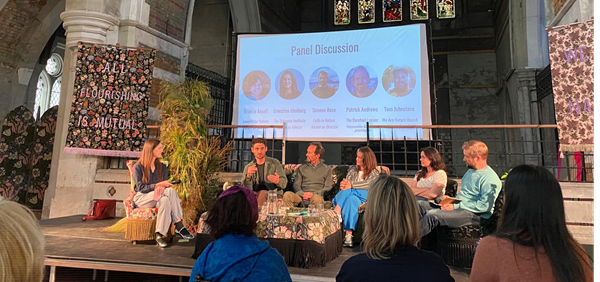
Jessie Mond Wedd led a panel on the importance of recognising — in language and our dictionaries — that we, humans, are nature. (Frieda Gormley, Tom Oliver, Jonathon Porritt, Kalpana Arias)
Brontie Ansell joined a panel on how to bring Nature — and its voice — into corporate governance structures with Nature on the Board (Ernestien Idenburg, Patrick Andrews, Simeon Rose, Tessa Van Soest, Lucy Ward)
Brontie Ansell and Paul Powlesland led a panel on Nature as a rights holder which covered the philosophical basis of rights of nature, Nature tribunals and how to begin to tell a new story about nature and law (Dr. Neil W. Williams, Lucy Gavaghan)
What we learned:
The Garden of Tomorrow can be a beautiful, kind and respectful place to all beings and all life and all of nature, we are some of the gardeners, we can all sow seeds for a more hopeful future. Practical positive action is the key. We can start to tell ourselves a new story right now. In fact we have a moral imperative to do so.
Satish Kumar’s speech
Satish Kumar’s speech was particularly enlightening. Here are some of his key points:
Humus is Latin for earth or ground. It is closely linked as a word to humanus and may share the same etymology. Therefore we can and should think of ourselves as coming from the earth, we are earth beings and we are soil transformed into consciousness by the work of nature.
In Nature, beauty is plentiful; In our human-made world beauty is lacking. Nature teaches us about beauty (balance, proportion, harmony and a sense of relationship) and we need to listen more. We have lost something in our utilitarian landscapes. This affects our connection with nature.
The word Economy is derived from Latin and means ‘home management’. Ecology as a word can be traced to Ancient Greek to mean ‘home knowledge’ or study of home. Our economic policy does not respect the link between our money systems and our home. Our home being Nature and our planet. We cannot have money systems without respect for our home.
We are in the midst of a transformation as profound as the Copernican Revolution, where an idea took 150 years to move through the church and society to become accepted as fact. In 150 years, we will be shocked that Nature did not always have rights. But the work starts today for all of us.
Often, Satish Kumar, and many of us in this movement are called idealistic. Satish begs the question, “And what have the pragmatists achieved? War? Poverty? Global warming? So why not turn to idealists?”
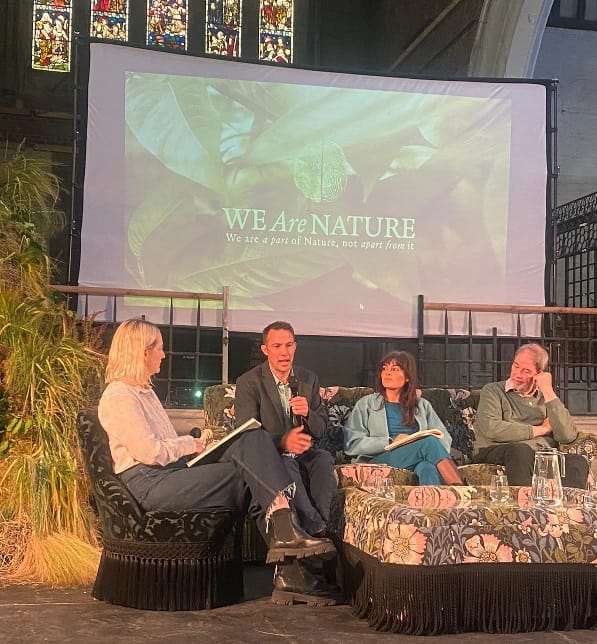
If you are not familiar with it, The Garden of Tomorrow, sponsored and supported by House of Hackney, is an annual festival of ideas that brings together positive disruptors, activists, artists and organisations to imagine and discuss a future where we are a part of Nature, not apart from it. In the face of the meta ecological & Nature crises, the Garden of Tomorrow invites us to come together to convert radical ideas into practical action today, to ensure a better tomorrow.
Share
Read more
The Potential of the COP26 Declaration on Forests and Land Use as a Nature-Based Solution to the Climate Crisis
Blog
November 23, 2021
Claire Nevin
,
The Glasgow Leaders’ Declaration on Forests and Land Use, the first major announcement of the COP26, commits 137 countries, including Brazil, China and Indonesia, to “halt and reverse” deforestation by 2030.
Read more
COP26 and the Climate Crisis: Draft Agreement Avoids Tackling Critical Issues as World Leaders Continue to Pass the Buck
Blog
November 29, 2021
Xi Yu
,
Six years ago, 193 countries signed the Paris Agreement which aims at limiting the rise in global average temperature well below 2C above pre-industrial level, with an aspirational target of reaching 1.5C.
Read more
Calling all Earth Lawyers
Blog
January 20, 2022
Paul Powlesland
,
We need ‘wild lawyers’, ‘lawyers for nature’ or ‘earth lawyers’: those committed to enacting and upholding the Rights of Nature through whatever legal avenues and means that are available.

.svg)


