
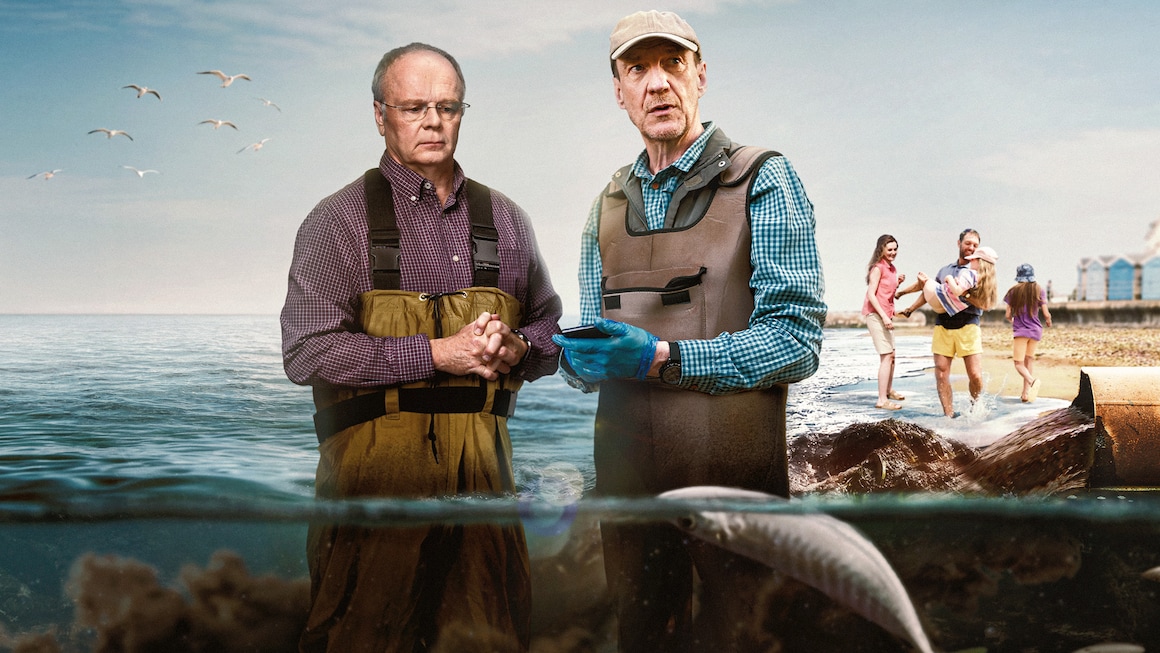
This week, Dirty Business aired on Channel 4. It tells a story many of us already know deep in our bones: Britain’s rivers are being illegally polluted on an industrial scale, and ordinary people have had to step in where government and institutions have failed. The programme is difficult to watch. It lays bare the human suffering behind the statistics, illness, loss, and betrayed communities that are the net result of this crisis. It shows the visceral anger felt by those who have discovered that what was presented as an unfortunate side-effect of heavy rain is, in reality, the predictable outcome of corrupt corporate decision-making and systemic regulatory failures.
But it also shows something striking and hopeful. Around the country, from Whitstable to the Windrush to Windermere, it is ordinary people who are stepping up, usually in their spare time, to fight back against sewage and protect our rivers, lakes and seas when the regulators have failed.
On water bodies across the land, volunteers are testing water quality, documenting discharges, monitoring outfalls and demanding accountability. They are doing so in their spare time, without pay, often without official backing. Dirty Business highlights the decade-long investigation by Ashley Smith (a retired investigative police officer) and Peter Hammond (a retired Oxford maths professor). Together they investigate suspicious sewage dumping in their local river, the River Windrush. When the water company’s explanation falls apart and the Environment Agency’s failings are exposed, they dig deeper. Together they uncover decades of underinvestment that have crippled water infrastructure, causing widespread environmental damage and thousands of cases of untreated sewage polluting rivers and seas nationwide. This is the work of local, ordinary citizens, giving up their own time to alert the public to the multiple systemic failures and the harm being done to our waterways.
Like other River Guardians, I have stepped up on the River Roding, where I live. The more I learnt about sewage on my river, the more I realised that no one in the water companies, the Environment Agency or the government had a clue about the true extent of the problem. I knew there were many illegal outfalls that were ‘unknown, unknowns’ and which could only be found by physically walking along the river to locate them, which the Environment Agency has not done in decades. Even for so-called Combined Sewer Overflows (CSO’s), which are permitted and fitted with monitors, the monitoring only covered the number of hours of sewage, so the authorities have no way of knowing the volume or concentration of sewage, and thus any real notion of the harm being caused to the river. As the realisation that nobody knows either the location or impact of every outfall on any river in England, I was left wondering how can the water companies or government fix a problem where they have no idea of its extent or seriousness?
Seeing the visible harm to the river I loved, I could not stand by and allow an unknown amount of sewage to continue to damage the river for decades to come. I therefore devised a simple but effective methodology to locate, test and rank the harm of each illegal outfall on the lower half of the river – which can be replicated on other rivers in the UK, something that Lawyers for Nature are working on this year.
Finding suspicious outfalls was relatively easy: I put on a pair of waders and walked the entirety of the lower river, testing any outfall entering it that looked questionable. The test for sewage was also reasonably easy: ammonia is an accurate indicator of the presence of sewage and its concentration a proxy for how damaging a particular spill is on the river. Using a hand held ammonia checker I was able to test for sewage beside the river, for pennies & in minutes. Volume was supposedly more difficult – both the water companies and the Environment Agency maintain they have no way of measuring it. However, with a cheap bucket, a timer and a measuring jug I was getting accurate results of the amount of water coming out of the different outfalls. Combining these pieces of information with the number of hours each outfall spills brought some massive and devastating numbers. A tributary of the Roding, the Cran Brook in Ilford, was discharging around 750 million litres of sewage and landfill leachate straight into the River Roding every year. A CSO at Buckhurst Hill was discharging 115 million litres of sewage every year that was so concentrated the whole river was showing ammonia levels of a sewer more than half a mile downstream. Another CSO was spilling more than 220 million litres of sewage in a constant stream for three whole weeks. Although these are the worst, there are dozens of other outfalls along the Roding spilling millions of litres of raw sewage into the river.
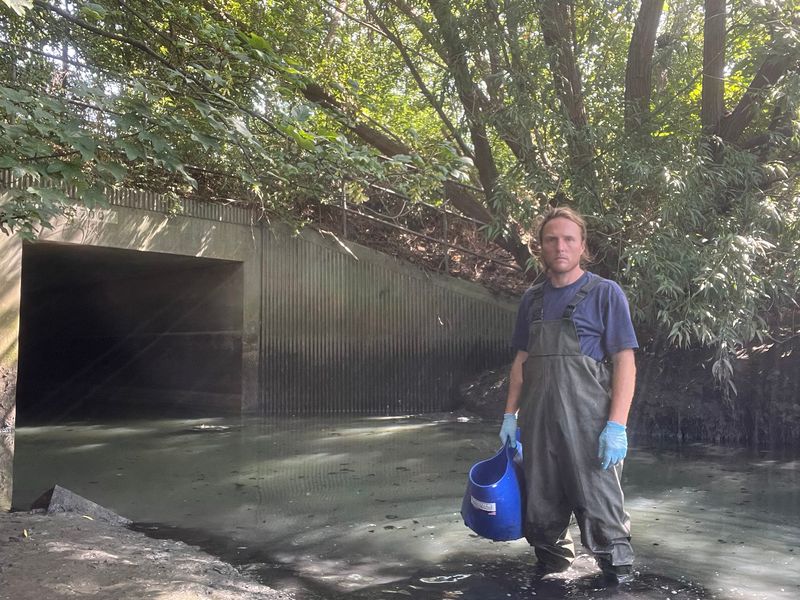
Despite the sheer number and severity of illegal sewage discharges on the Roding, there has not been a single prosecution on the Roding this century. Even worse, the Environment Agency had no idea about many of these outfalls and does no monitoring of the outfalls it does know about for either severity or illegality. It is left to volunteer River Guardians, who love their river and refuse to watch it die, to do the job (often in their spare time, for free) that the regulators refuse to do.
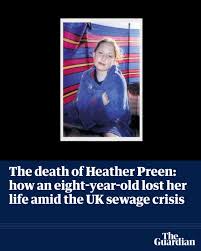
The UK sewage crisis is not simply about unpleasant sights or damaged wildlife. It is also about public health, dignity and justice. Families have now lost loved ones. Children are falling ill. In 1999, eight-year-old Heather Preen died after contracting E. coli O157 following a family holiday at Dawlish Warren beach in Devon, where contaminated water was later linked to sewage pollution. Her death, and the subsequent grief and trauma for her family, is now being highlighted in Dirty Business, which uses her story to expose decades of systemic sewage mismanagement by UK water companies. Despite multiple complaints about pollution at the beach before the outbreak, no definitive source was ever identified, and her mother continues to campaign for water safety and accountability. As I looked around the room at the screening of the film last week, I realised I wasn’t the only one sitting in grief. I saw that people were struggling with sadness and anger, with tears on their faces.
Communities have been denied safe access to the waters that run through their neighbourhoods. Meanwhile, water companies have continued to distribute dividends, service vast debts and reward executives. This is even as infrastructure has deteriorated and illegal discharges have persisted. Enforcement has been slow and prosecutions have been rare. Fines, when imposed, are often absorbed as operational costs rather than treated as meaningful deterrents. Regulators have too often managed unacceptable levels of pollution rather than prevented it. The result is a perverse system in which rivers absorb the consequences of financial engineering, while the public absorbs the health risks.
We, at Lawyers for Nature, believe that Nature should have rights. We act as though it does. To that end, we imagine a system where all rivers have voices in the systems that govern them. A fully funded system of River Guardianship around the UK is the intervention that is essential for the health of rivers, humans, and all more than human entities.
Our rivers currently have no voice within the system that governs them. They are treated as passive recipients of discharge permits, they are seen as compliance categories and as externalities to be managed. River Guardianship offers a different model for us and the more than human communities that need our rivers.
Guardianship means formally recognising that rivers require representation within governance structures. It means appointing independent guardians with legally enforceable duties to protect the health, integrity and long-term resilience of river systems. It means shifting from a framework that tolerates pollution within limits to one that prioritises ecological recovery and public safety.
If water companies were required to embed independent ecological guardians within their governance structures, this means individuals owing fiduciary duties to the river, decisions about infrastructure investment, maintenance, and risk would look very different. If regulators were under a clear statutory duty to prioritise ecological integrity rather than manage discharge allowances, weeks-long spills would trigger urgent intervention rather than bureaucratic delay.
Guardianship does not replace regulation, it strengthens it. It ensures that someone within the system is explicitly responsible for defending the river’s interests. This would not be a public relations exercise, but a legal obligation. We imagine a world where every river has a guardian or team of guardians, where each catchment area can come together to care for their river. Then, representatives from each catchment could come together in a River Parliament that can advocate for, care for and protect the waterways across the country.
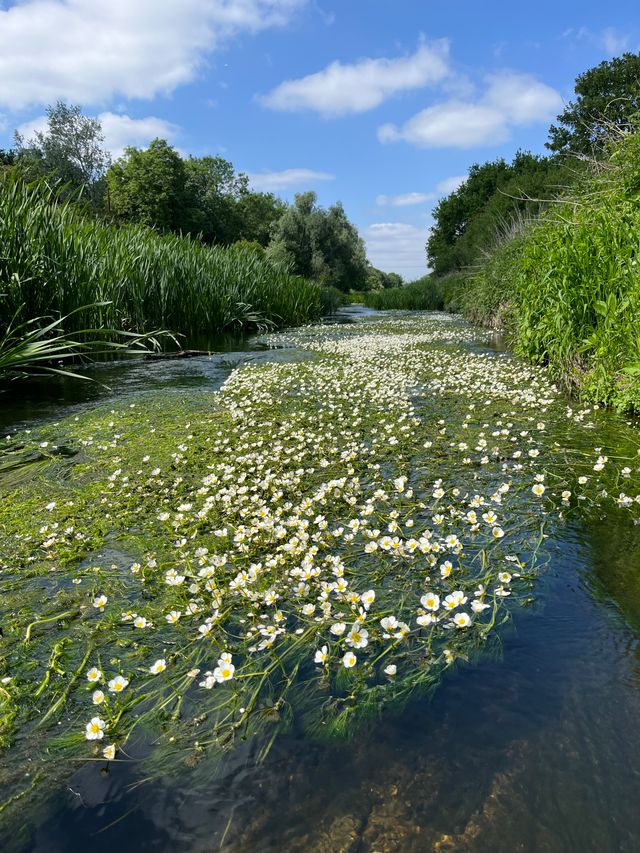
Dirty Business exposes what has gone wrong. Local volunteers have shown what courage and care look like. But we cannot build the protection of our rivers on volunteerism alone. Citizens should not have to climb fences and trespass in the dark to uncover illegal sewage spills. Communities should not have to fight to simply secure clean water.
The sewage crisis has revealed a void at the heart of our water governance: no one is formally tasked with defending the river itself. River Guardianship fills that void. It embeds care into law. It aligns accountability with ecological reality. And it moves us from reacting to scandal toward building a system designed to prevent it. The time for outrage is not over, but it must now translate into structural change.
The system needs to be overhauled. Regulation needs to be stringent and enforced. Water companies should go into public ownership.
Our rivers need legal rights and a system in place to enable the guardians working around the UK to continue doing the wonderful work to protect our waterways.
Become a river guardian or support river guardianship today.
Paul Powlesland will be holding a live Q&A with others working on critical sewage issues on Tuesday 3rd March, 7pm - 8pm to discuss the issues raised in the docudrama and what legal and community action can achieve next.
To attend this event please fill in this Google Form by Monday 2nd March.
Support our work and the work of:
Sign this petition to return the water industry to public ownership and write to your MP.
.svg)
Share


This is a story about Lawyers for Nature’s work on what was variously known as the Dulwich Oaks or Save the Footbridge Oaks Campaign. I was contacted out of the blue by a member of the campaign who had heard about Lawyers for Nature and our work saving trees.

